Showing posts with label adventure. Show all posts

Tuesday, 16 September 2014

#88 - Yamadera, a mountain-top temple

Yamadera (山寺), meaning mountain temple, is built in the mountains of Yamagata Prefeture. It was founded in 860 as a temple of the Tendai Buddhist sect. It is a great place for a short hike and for some great views. In most guide books I have seen, Yamadera is mentioned as a good side trip from places like Sendai, although you would have to travel a little ways to get there.

At the base of the mountain, you can find several temple buildings. The oldest building here houses a flame which is said to have been burning since Yamadera was founded. There are also some small shops for food, water and other things! I managed to buy a shrine book with a lovely picture of Yamadera on it (unfortunately, I didn't actually use it because I was yet to fill my other book with stamps!).

In the upper area.
Climbing up.

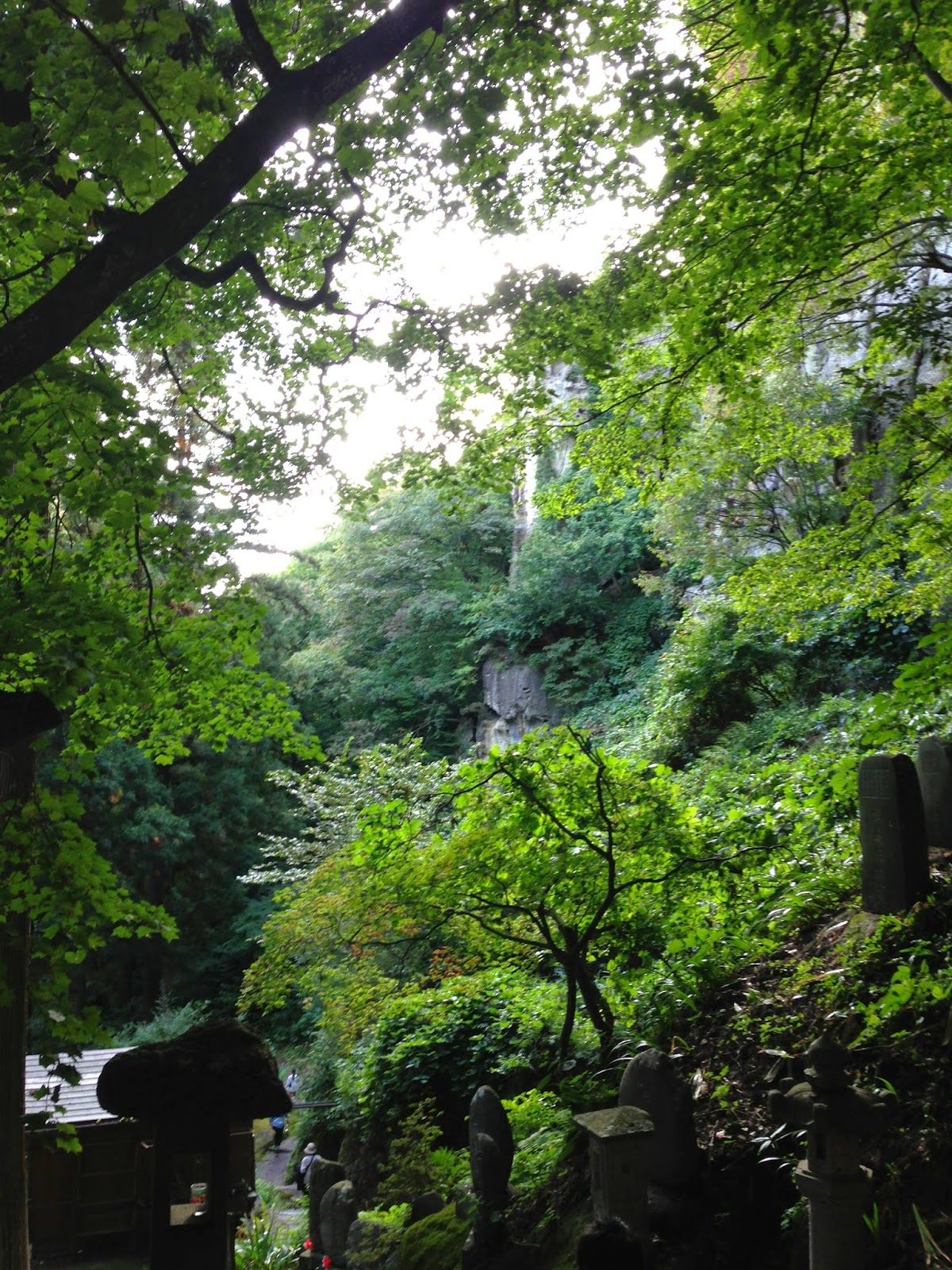
To get up the mountain, you will need to climb around 1000 steps, which can be a bit of a hike. You can see stone lanterns and small statues as you ascend. Needless to say, I was exhausted as I got to the top!

There are many buildings scattered near the top, and I could see other areas, such as a balcony-like seat in the rock face. Unfortunately, my bus going there arrived late, so I didn't have time to have a good look around. Added to my rushed hike (run?) up the mountainside, I really didn't have a good opportunity to take it all in anyway!

View of the valley.
From the upper areas, there is a great view of the surrounding valley. Luckily, the weather was good when I visited, so it looked great!


Yamadera is also famous for one of the places visited by the poet Basho. He wrote one of his well-known haikus here in 1689, which mentions the stillness and quietness of Yamadera. Here is an English translation:

"ah this silence / sinking into the rocks / voice of cicada"

Although my time there was short, I did enjoy being able to visit Yamadera. It was a place I had been wanting to visit since living in Sendai. If I am able to visit the region again, I would love to spend some more time here to leisurely take in the atmosphere. But, I'm not sure if I'll be thrilled about climbing up again!

Tuesday, 2 September 2014

#86 - Matsushima: A Wet Experience!

Matsushima is a group of islands and bay in Miyagi Prefecture, Japan and is a short trip from Sendai. The name 'Matsushima' explains it quite clearly - matsu (松) means pine tree, and shima (島) means island. So, 松島 means islands covered in pine trees.

This area is known as one of the Three Views of Japan, so a lot of visitors are drawn here. There are also plenty of temples to occupy your time and several mausoleums.

The sand and rock garden
in Entsuin temple.
Some parts built into the rock face.

Shoes off!

Unfortunately, I didn't have a good chance to see a lot of the sites, because it started to rain. Actually, it was a bit more than just rain. A typhoon was coming that weekend, so the streets became flooded pretty quickly! To try and lessen any damage, I took my shoes off to walk towards the train station. As it turned out, water had flooded some of the train tracks coupled with some strong wind further down the line meant that the trains were stopped and weren't about to go any time soon!

After it stopped raining, the water across the roads disappeared extremely quickly! Look at the comparison in these photos!

With rain...
...and the same place without rain!
Because it had gotten a little sunnier (and also because I needed another way back to Sendai...) I boarded on one of the ferries. Usually, ferries make round trips so that you can get a little closer to the islands. As I found out, children (and some adults) spend the journey throwing prawn flavoured snacks off the back of the boat to attract armies of seagulls! It was a little scary!
A view of Godaido, a small temple hall.
A different seagull-swamped ferry.


A wet me on the ferry.

Another small island.
An island.


Regardless of the typhoon and not being able to see much, I still really enjoyed visiting Matsushima! The typhoon was interesting to experience and it was kind of like an adventure - I will never forget it for sure! I would like to go again in the future to see everything I can.

Tuesday, 5 August 2014

#83 - Mount Kōya

South of Osaka lies Wakayama Prefecture, and there in an 800 metre high valley in the mountains lies the centre of Shingon Buddhism. The founder of this sect is one of Japan's most significant religious figures. Kukai (空海), also known as Kobo-Daishi after his death (弘法大師, The Grand Master Who Propogated the Buddhist Teaching) settled in Mount Koya in 819, and began to develop a monastery. Legend has it that, while studying in China, he threw his sankosho (a tool used in Buddhist ceremonies) towards Japan. Later, he found the tool stuck the branches of a pine tree on Mount Koya, and that's why he started to build his monastery there. The pine tree is still growing in the complex!

Today, the monastery has developed into the town of Koya (高野).  For visitors, there are about 120 temples and shrines to visit, as well as memorials and other structures. There is plenty to keep you busy for a day, but many people stay overnight. Around 50 temples offer lodging (called shukubo), so you can experience the simple, traditional lifestyle of Buddhist monks! And, Mount Koya is one of the best places to do it.

Okunoin 奥の院

The bridge towards Kobo-Daishi's mausoleum. 
Surrounded in forest trees, Okunoin is the site of Kobo-Daishi's mausoleum. It is believed that he didn't actually die, but instead he rests in eternal meditation awaiting the Buddha of the Future. Many people come to this site to pray at this popular pilgrimage spot. You can feel that it is a sacred site. There is a small bridge to cross, and you should bow to pay respects to Kobo-Daishi before crossing. Photography, food and drink are all forbidden past this point.

Between the trees.
Many people, such as prominent monks and feudal lords, wished to be close to Kobo-Daishi in death, and so they had tombstones erected here. This is Japan's largest cemetery, with over 200,000 tombstones. It is about 2 kilometres in length to walk the main path here.

Part of the pathway.
There are a lot of tall forest trees scattered throughout the area, and it makes the walk very atmospheric. You can definitely feel something spiritual here! Many guidebooks recommend walking through Okunoin at night, as it provides a very different experience than during the day. In the dark, it really feels like another world!

Kongobu-ji Temple 金剛峯寺

Kongobu-ji front.
Originally constructed in 1593 by Toyotomi Hideyoshi (豊臣秀吉) in dedication of his mother, Kongobu-ji has now become the head temple of Shingon Buddhism. You can enter this building and see the rooms, including beautifully gilded sliding doors, audience rooms and kitchen.

A prominent feature of this temple is its rock garden. Called Banryutei (蟠龍庭), it is the largest rock garden in Japan (2340 square metres). The large granite stones were brought from Shikoku, the island where Kukai was born, and the arrangement is said to represent two dragons emerging from a sea of clouds to protect the temple.
The rock garden, Banryutei.

Pilgrimage Trails

Daimon Gate. 
Due to the vast number of temples and its historical and religious importance, there are a number of popular pilgrimage trails which connect Mount Koya to the outside world. Many people now use the cable car, but you could also hike the trails across the mountains using a more traditional approach. It is also the start and end point of the Shikoku 88 Temple Pilgrimage.
With Koya-kun, a mascot character.


Whether you want to hike to Koya, or just walk around it, there are plenty of smaller temples to see. You may even see the mascot, Koya-kun, like we did! Actually, you can sometimes find a picture of Koya-kun at some sites. Why? Standing behind him gives a good angle for photographs!

Candle Festival: ろうそく祭り

A path with candles.
I went to Mount Koya during Obon, a Buddhist event for commemorating your ancestors. Traditionally, lanterns are hung in front of houses, graves are visited and Obon dances are performed! It is a very important event for most people in Japan.

At Mount Koya, they hold a candle festival. The paths in Okunoin are lined with polystyrene and foil. This is so you can place lit candles into them. These run all along the entire trail of the forest, which is quite impressive! You can buy candles from stalls, so we didn't need to have our own luckily! 

Me lighting and placing a candle.
Walking through the forest and cemetery along a path of light was a very interesting experience. Hundreds of people were there to enjoy the festival. There was something spooky and spiritual about the event. 

At one part, there were some unlit steps. As we passed, a small girl in a white kimono silently appeared from the darkness. A Japanese woman saw this and almost screamed from fright and it looked like she was about to have a heart attack! Little girls in white dresses are an image of a ghost in some folklore, so that's why it freaked her out so much! 

Overall Impressions

I really enjoyed visiting Mount Koya. It was a place with a lot of nature, and it is really relaxing to walk around the small town and visit the temples and buildings. It was by total accident that the Candle Festival was happening. I didn't know about it before going! However, I will always remember that experience as unique. I would love to visit Mount Koya again, perhaps to stay overnight at temple lodgings! I didn't have a chance to do it before, because I only went there for one day. Perhaps in the future!

Tuesday, 29 July 2014

#82 - Nara : Temples, shrines, and deer

Nara is a city in the Kansai region of Japan. Nara Prefecture is located next to Kyoto Prefecture and makes for a good short trip for a day or two. Nara (奈良) was Japan's first permanent capital city from 710 until 784, which thus made of most of the Nara Period. Nowadays it has been designated a UNESCO World Heritage Site for the so-called "Historic Monuments of Ancient Nara". This is made up of eight temples, shrines and ruins, the Heijo Palace (平城宮 Heijou-kyuu) and the Kasugayama Primeval Forest. This has made Nara an important stop for temple-hoppers and history lovers.

Temples and Shrines

The eight UNESCO sites are: Todai-ji (東大寺), Saidai-ji (西大寺), Kofuku-ji (興福寺), Kasuga Shrine (春日大社), Gango-ji (元興寺), Yakushi-ji (薬師寺) and Toshodai-ji (唐招提寺). Nara is a fairly small place, so it should be fairly easy to get around to visit them. I won't go into a lot of detail about each temple or shrine here, but I will tell you some of the highlights.

The big Buddha at Todai-ji.

Todai-ji (東大寺) is one of the most famous temples in Japan and one of the most historically significant. In its main hall, you can see the Big Buddha known as Daibutsu (大仏). It is one of Japan's largest bronze statues of Buddha, which is 15 metres tall.

Horyu-ji Temple.
Horyu-ji (法隆寺) is one of Japan's oldest temples, dating from the 7th century. It was founded by Prince Shotoku, who is said to have introduced Buddhism to Japan. Some of the buildings within the area are the world's oldest surviving wooden structures. Additionally, Horyu-ji is wheelchair accessible, which is unlike many other historic attractions in Japan.
Kofuku-ji Temple.

Kofuku-ji (興福寺) was once the temple of the Fujiwara clan, the most powerful family clan during the Nara and Heian Periods. At one time it had over 150 buildings, but today only a couple remain. Here, you can see Japan's second tallest five story pagoda, which stands at 50 metres tall and is a symbol of Nara. Entrance to Kojuku-ji's grounds is free but you will have to pay to enter some of the buildings.

Deer

Sign about the deer.
Apart from the historical sites, Nara is also famous for its deer. Around the Nara Park area, many wild deer roam freely. You can usually find small stalls selling deer crackers (鹿煎餅 Shika-senbei) if you want to feed them. The deer in Nara are known to be a little adventurous, and will sometimes approach you boldly and try to take your food (like ice cream) from you! 

In Nara Park.
According to folklore, the god Takemikazuchi-no-mikoto appeared from a mountain riding a white deer and therefore the deer in this area are considered sacred. Killing one of these deer was punishable by death up until 1637! Today, however, the deer no longer have their divine status, but have instead been designated as national treasures.


How to get there

Nara is within easy reach from Kyoto. There is a JR train which operates between Kyoto Station and Nara Station. It costs about 710 yen for a one-way ticket and takes 45 minnutes. This is covered under the JR Rail Pass. 

You could also use the Kintetsu Railway which travels from Kyoto Station to Kintetsu Nara Station. Because it is a private railway, its costs a little more, usually around 1,130 yen one-way. The journey takes about 35 minutes.

Tuesday, 17 June 2014

#76 - Tokyo Tower

Tokyo Tower (東京タワー ) is a communications and observation tower in Tokyo. Standing at 333 metres tall, it is the second tallest structure in Japan (after this tower).Construction was completed in 1958, and Tokyo Tower remains a popular attraction for tourists to this day. I visited in the middle of July, 2013 and loved it!

History

After television broadcasting started in Japan in 1953, it was feared that a lot of transmission towers would be built across Tokyo. In order to prevent this happening and potentially overrunning the city, it was decided to construct one large tower to service the whole area. 
Looking up.

Did you know that, originally, Tokyo Tower was planned to be bigger than the Empire State Building? Unfortunately, due to a lack of resources and financing, this wouldn't be the case. 

Japanese architect Taichu Naito (内藤 多仲) was responsible for the design of Tokyo Tower. The lattice tower was based on the Eiffel Tower in Paris, France. But, when the 90 metre antenna was placed on Tokyo Tower, it overtook the Eiffel Tower to become the tallest free-standing tower in the world at that time! Like its French counterpart, Tokyo Tower came to be a symbol of its city.

Things to do


Tokyo Tower offers great bird's eye views of Tokyo. There are two observation decks: the main observatory at 150 metres, and the special observatory at 250 metres. On a clear day, you can see Mount Fuji! Unfortunately it was a little drizzly when I went, so I couldn't see it. Nevertheless, I really enjoyed looking out across Tokyo, and identifying other buildings and areas I had visited!

A view from Tokyo Tower.
At the time I visited Tokyo Tower, it was becoming late afternoon. I stayed until after the sun had set, and saw Tokyo light up! The views were great and it was a wonderful way of looking back on all the things I had done in Tokyo. 

Looking towards the Rainbow Bridge
 and Odaiba.
Looking up at night.

Tokyo at night.


Finally, underneath the tower, there is a four-storey building called FootTown. Here, there is an aquarium, reception hall, restaurants, convenience stores, and of course - elevators to climb the tower. You can also visit the Guinness World Records Museum Tokyo on the third floor. Also, on the roof of the building there is a small amusement park for children.

Monday, 21 September 2009

#56 - Ruhrsee

This weekend me and a couple of friends decided to go on a small trip. As one of them was told by someone at their univeristy about a place with lakes and lovely scenery, we decided to go to Ruhrsee.Although the weather was not the best (and thankfully it didn't rain) it was still a really nice place to visit. What I noticed the most was how quiet it seemed to be in the area. Just looking around makes you feel peaceful.

Ruhrsee is a small village on the bank of a river, which connects several lakes. We took a boat trip along one of them to a dam, which looked very interesting. It also had what looked like steps for a giant going down the side. Also, in the After higher area of the water stopped by the dam (I don't know the technical name for it) you could see the sun reflect in the water, and as it wasn't too bright and also because there were clouds, and also due to the stillness of the water, it looked as though there was something under the water glowing.

Going back and quickly having something to eat, we got on another boat and this time headed in an opposite direction, passing sailing boats and people swimming. Although the bus ride took almost 2 horus to get there, it was worth it. Perhaps I will visit there again for a week on holiday in the future, and swim and sail in the beauty!

Tuesday, 15 September 2009

#55 - Berlin Weekend

As part of an excursion with the summercourse, I went on a trip this weekend to Berlin. I had never been to Berlin before, and so I wanted to see it as I had the chance.

On Friday morning at around 7am we left on the bus. The journey to Berlin took about 10 hours, so it felt very long! We arrived at our hostel in the east of Berlin which was actually quite nice. After a few rules from the hostel we shared out the rooms.

On Saturday there was a meeting at Checkpoint Charlie and then a tour organised for the afternoon. I missed otu on both of these due to getting lost on the train and then not being told where the meeting place for the tour was. Nevertheless I wandered around Berlin's 'centre' with a friend and saw most of what we wanted to see, and had fun too. In some ways I think going by ourselves was better, as we had more freedom than we would have on a 3 hour Stadtrundgang.
On Sunday we decided to go to Berlin Zoo. It is very big, and as we had no map of it we got lost very easily. It was quite relaxing to see all the animals, and in the Aquarium it was interesting to see the fish and other water creatures. Unfortunately my battery in my camera ran out just as we arrived at the aquarium so I have very little photos of that!

In the end we ended up having to rush both the Zoo and Aquarium because we were going to join the 4pm boat tour organised for us. Of course we missed this too, so spent a while sitting around Berlin Dome while a small brass band (possibly from a school) started to play music. We eventually met up with the others who went on the tour and followed them (lead by one of the teachers) onto the train and to another part of Berlin. I do not know why we went there, as it consisted of an hour or more just walking around the streets. The only sights to see were Turkish restaurants and the odd quasi-interesting poster on the side of a building. So after reaching a U-Bahn station, I left the group, and because it was getting fairly late evening, went back to the hostel.

Monday morning we had to leave our rooms by 10. As the bus was arriving at 13, I went on a small walk around the area. We headed along the main street just to see what was there, and eventually found ourselves exploring a cemetery, which sounds really grim, but it was actually really interesting. There were of course headstones there, but a little further in and under the older trees and plants were big family graves. It also turned out that the little church in the middle I wanted to take a look at was not a church at all but another big (and no doubt expensive) family tomb!

The bus ride back to Aachen was so long and uncomfortable. It didn't help that the woman in front of me put her seat right back as far as it would go, basically giving me no space to sit. She didn't even lay back on the seat, but she led on the bottom part of it across 2 seats, so why she needed the extra flatness I do not know! And when she wasn't laying down, she sat upright and read magazines!

Wednesday, 9 September 2009

#54 - Maastricht

On the weekend I went with a small group of us from the summer course on a day trip to Maastricht. It doesn't take very long on the bus, and the return ticket only costs 5 Euro so it was quite cheap!
Maastricht Main Train Station
Maastricht as a town was very nice. There are quite a lot old building facades and the river is also a nice sight. The weather helped a lot by being very sunny and warm! We took a walk around the centre and town area, looking at the lots of shops they have. Most of them are quite expensive though so nobody bought anything!


We did have some waffles there, and they were delicious! I asked for a chocolate one, and basically to make that you take a normal waffle and push chocolate sticks into the middle of it, and the heat from the waffle melts it a little after a while. The smell of them as you walk down the street is amazing!

Thursday, 13 November 2008

#1- Introduction

Although it's rather late to start writing a blog, I have decided that it is a good idea nonetheless.

But before explaining that, let me introduce myself a little. My name is Alex, currently 21, and I am a university student from England studying French, German and Japanese. I am now in my 3rd year of my 4 year course, and this means that I have to go on a year abroad to live and learn in the countries where my languages are spoken. Since Septemer I have been in Osaka, Japan, attending Kansai University. After this, in January I will be heading to Strasbourg, France, and while there I will have to organise a summer course at a German univeristy.


True, it is now November, I have missed so many blogging oppurtunities! But I have decided to start blogging for a few reasons; because it would help ease moments of boredom; to rant about silly things like strange customs; to boast about where I am and what I am doing(!); but mostly, because it would be nice to have an account of what I have done to look back on.

So, to help start off, here are some few things about what I am doing. As I said above I am currently an international student at Kansai University, which is is Suita City which is in Osaka. I live in the male dorm and share a room which a Japanese named Tsuyoshi. He is a cool guy, but hardly ever here so I rarely get to speak with him. I am taking 8 classes, 7 is the compulsary number (of classes for international students) but I am also taking an extra normal university class for no credit (i.e. it's for regular Japanese students!). Some of the classes are quite hard, and the others are so easy it's barely a class. To be honest, I have spent most of my time with the Americans and other international students from my dorm so I have fallen into the habit of speaking more english than Japanese, but I am aiming on changing that!


In the following blogs to this one, I will try to recap on the field trips I have been on and where I have visited, and of course provide a few photos !

I also have a youtube channel although I don't really have much time to update it a lot, but it has some older blog videos and some more fun ones.

http://jp.youtube.com/user/6atale Subscribe :)


じゃ、また

Alex