Showing posts with label buddhist. Show all posts

Tuesday, 16 September 2014

#88 - Yamadera, a mountain-top temple

Yamadera (山寺), meaning mountain temple, is built in the mountains of Yamagata Prefeture. It was founded in 860 as a temple of the Tendai Buddhist sect. It is a great place for a short hike and for some great views. In most guide books I have seen, Yamadera is mentioned as a good side trip from places like Sendai, although you would have to travel a little ways to get there.

At the base of the mountain, you can find several temple buildings. The oldest building here houses a flame which is said to have been burning since Yamadera was founded. There are also some small shops for food, water and other things! I managed to buy a shrine book with a lovely picture of Yamadera on it (unfortunately, I didn't actually use it because I was yet to fill my other book with stamps!).

In the upper area.
Climbing up.

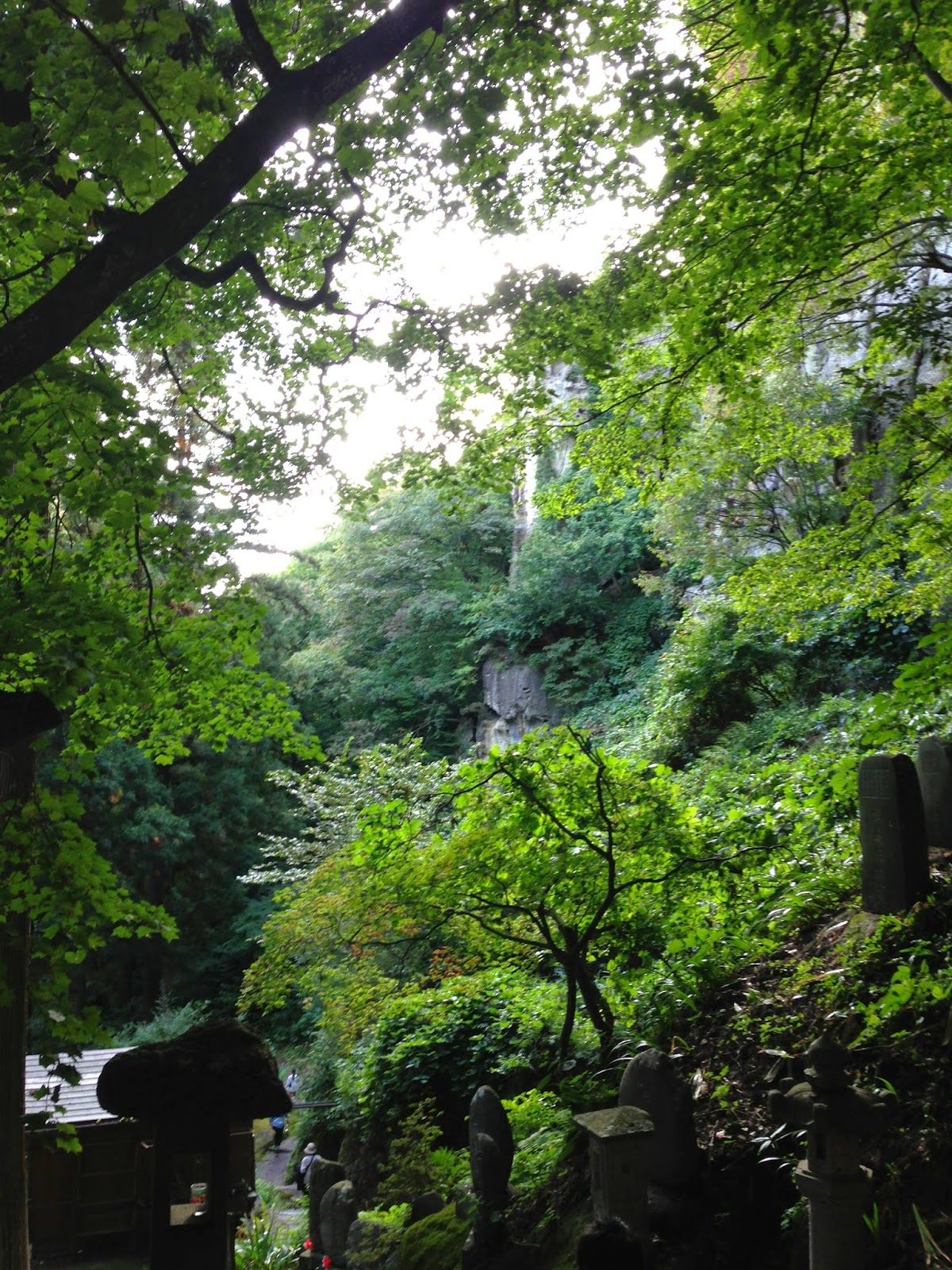
To get up the mountain, you will need to climb around 1000 steps, which can be a bit of a hike. You can see stone lanterns and small statues as you ascend. Needless to say, I was exhausted as I got to the top!

There are many buildings scattered near the top, and I could see other areas, such as a balcony-like seat in the rock face. Unfortunately, my bus going there arrived late, so I didn't have time to have a good look around. Added to my rushed hike (run?) up the mountainside, I really didn't have a good opportunity to take it all in anyway!

View of the valley.
From the upper areas, there is a great view of the surrounding valley. Luckily, the weather was good when I visited, so it looked great!


Yamadera is also famous for one of the places visited by the poet Basho. He wrote one of his well-known haikus here in 1689, which mentions the stillness and quietness of Yamadera. Here is an English translation:

"ah this silence / sinking into the rocks / voice of cicada"

Although my time there was short, I did enjoy being able to visit Yamadera. It was a place I had been wanting to visit since living in Sendai. If I am able to visit the region again, I would love to spend some more time here to leisurely take in the atmosphere. But, I'm not sure if I'll be thrilled about climbing up again!

Tuesday, 5 August 2014

#83 - Mount Kōya

South of Osaka lies Wakayama Prefecture, and there in an 800 metre high valley in the mountains lies the centre of Shingon Buddhism. The founder of this sect is one of Japan's most significant religious figures. Kukai (空海), also known as Kobo-Daishi after his death (弘法大師, The Grand Master Who Propogated the Buddhist Teaching) settled in Mount Koya in 819, and began to develop a monastery. Legend has it that, while studying in China, he threw his sankosho (a tool used in Buddhist ceremonies) towards Japan. Later, he found the tool stuck the branches of a pine tree on Mount Koya, and that's why he started to build his monastery there. The pine tree is still growing in the complex!

Today, the monastery has developed into the town of Koya (高野).  For visitors, there are about 120 temples and shrines to visit, as well as memorials and other structures. There is plenty to keep you busy for a day, but many people stay overnight. Around 50 temples offer lodging (called shukubo), so you can experience the simple, traditional lifestyle of Buddhist monks! And, Mount Koya is one of the best places to do it.

Okunoin 奥の院

The bridge towards Kobo-Daishi's mausoleum. 
Surrounded in forest trees, Okunoin is the site of Kobo-Daishi's mausoleum. It is believed that he didn't actually die, but instead he rests in eternal meditation awaiting the Buddha of the Future. Many people come to this site to pray at this popular pilgrimage spot. You can feel that it is a sacred site. There is a small bridge to cross, and you should bow to pay respects to Kobo-Daishi before crossing. Photography, food and drink are all forbidden past this point.

Between the trees.
Many people, such as prominent monks and feudal lords, wished to be close to Kobo-Daishi in death, and so they had tombstones erected here. This is Japan's largest cemetery, with over 200,000 tombstones. It is about 2 kilometres in length to walk the main path here.

Part of the pathway.
There are a lot of tall forest trees scattered throughout the area, and it makes the walk very atmospheric. You can definitely feel something spiritual here! Many guidebooks recommend walking through Okunoin at night, as it provides a very different experience than during the day. In the dark, it really feels like another world!

Kongobu-ji Temple 金剛峯寺

Kongobu-ji front.
Originally constructed in 1593 by Toyotomi Hideyoshi (豊臣秀吉) in dedication of his mother, Kongobu-ji has now become the head temple of Shingon Buddhism. You can enter this building and see the rooms, including beautifully gilded sliding doors, audience rooms and kitchen.

A prominent feature of this temple is its rock garden. Called Banryutei (蟠龍庭), it is the largest rock garden in Japan (2340 square metres). The large granite stones were brought from Shikoku, the island where Kukai was born, and the arrangement is said to represent two dragons emerging from a sea of clouds to protect the temple.
The rock garden, Banryutei.

Pilgrimage Trails

Daimon Gate. 
Due to the vast number of temples and its historical and religious importance, there are a number of popular pilgrimage trails which connect Mount Koya to the outside world. Many people now use the cable car, but you could also hike the trails across the mountains using a more traditional approach. It is also the start and end point of the Shikoku 88 Temple Pilgrimage.
With Koya-kun, a mascot character.


Whether you want to hike to Koya, or just walk around it, there are plenty of smaller temples to see. You may even see the mascot, Koya-kun, like we did! Actually, you can sometimes find a picture of Koya-kun at some sites. Why? Standing behind him gives a good angle for photographs!

Candle Festival: ろうそく祭り

A path with candles.
I went to Mount Koya during Obon, a Buddhist event for commemorating your ancestors. Traditionally, lanterns are hung in front of houses, graves are visited and Obon dances are performed! It is a very important event for most people in Japan.

At Mount Koya, they hold a candle festival. The paths in Okunoin are lined with polystyrene and foil. This is so you can place lit candles into them. These run all along the entire trail of the forest, which is quite impressive! You can buy candles from stalls, so we didn't need to have our own luckily! 

Me lighting and placing a candle.
Walking through the forest and cemetery along a path of light was a very interesting experience. Hundreds of people were there to enjoy the festival. There was something spooky and spiritual about the event. 

At one part, there were some unlit steps. As we passed, a small girl in a white kimono silently appeared from the darkness. A Japanese woman saw this and almost screamed from fright and it looked like she was about to have a heart attack! Little girls in white dresses are an image of a ghost in some folklore, so that's why it freaked her out so much! 

Overall Impressions

I really enjoyed visiting Mount Koya. It was a place with a lot of nature, and it is really relaxing to walk around the small town and visit the temples and buildings. It was by total accident that the Candle Festival was happening. I didn't know about it before going! However, I will always remember that experience as unique. I would love to visit Mount Koya again, perhaps to stay overnight at temple lodgings! I didn't have a chance to do it before, because I only went there for one day. Perhaps in the future!

Tuesday, 13 May 2014

#71 - Golden week in Kyoto - 28 April to 3 May 2013

Golden Week is a period of time in Japan where many public holidays fall in a very short space of time. Some companies close for this week. For most people, Golden Week (sometimes known as GW) is almost a week of holiday. Of course it goes without saying that this is the travel period! Flights, trains, hotels; everything will be fully booked (and expensive!). Make sure to book in advance!

I took this opportunity to go to Kyoto for a week. During that time, I managed to visit a lot of different places, and it remains one of my favourite holidays. I could write a very, very long entry about it all, but I think I will choose a few of the highlights.


Tourist map I found using a web search.
It shows the locations of the more popular spots.

Kyoto

Kyoto (京都) is in the central part of the largest island of Japan (Honshu 本州). About 1.5 million people live there, making it the seventh largest city in Japan. It was formally the imperial capital city of Japan for over a thousand years, so there are many impressive buildings. Of course, this makes it a popular destination for tourists. Many people try to spot geisha in the Gion district. I also tried, but failed.

It is very easy to get around Kyoto as a tourist. There are frequent buses that go throughout the city and stop at, or near, popular and historic sites. So, buying a day pass is great!

Kiyomizu Temple

Kiyomizu Temple (Kiyomizudera 清水寺, which means "pure water temple") is a Buddhist temple and a UNESCO World Heritage site. There is a wooden stage which reaches our from the main hall, which is about 13 metres above the hillside. This is maybe one of the most well-known views in Kyoto. Also on the site, there is a small love shrine with two stones placed 18 metres apart. It is said that if you can walk from one stone to the other with your eyes closed, then you can have good luck in love. Someone can help you walk between the stones, but it is then believed that someone will have to be an intermediary in your love life too.
My panorama of Kiyomizudera.
There are also lots of things to see within the temple grounds. For example, there is the Otowa waterfall. At one point, the water is divided into three streams by a structure. Each represents something different: long life, academic success and love. Using a cup on a long stick, you can drink the water and receive good luck. But apparently, if you drink from more than one, you are considered to be greedy. I waited in line to do this. The line was long! I drank from the middle one. I'm still not entirely sure which type of fortune it represented, but I hope it was love.

Kiyomizudera has great views during cherry blossom season and also during autumn, where the leaves turn red.

Kinkaku-ji

Kinkaku-ji (金閣寺 Temple of the Golden Pavilion) also known as Rokuon-ji (鹿苑寺 literally, "Deer Garden Temple") is a Zen Buddhist temple which is covered in gold leaf. This is one of the most visited sites in Japan. As soon as you enter the gardens, you can see the pavilion across a large pond. The gardens are also lovely to walk through. I really enjoy looking at nature and plants, so I found it very relaxing. At one point there was a bowl near some small statues, with people throwing money into it, trying to get good luck if you get your coin inside. I did it three times! There is also a tea garden, where you can try green tea (matcha 抹茶) which is a famous type of tea from Kyoto.
Kinkaku-ji and pond.

Ginkaku-ji

Ginkaku-ji (銀閣寺 Temple of the Silver Pavilion) is one of my favourite places. It is a Zen temple in the east of Kyoto. It has a garden which has a quiet atmosphere which includes a moss garden and ponds, and a unique dry sand garden. The trail also leads partially up a hill, so you are able to see across the grounds and a view of Kyoto city behind it. The atmosphere was so relaxing and the plants and gardens were beautiful. I really want to visit again and again (or, when I am rich in the future, I can create my own garden like it!) 
Although it is called the "Silver Pavilion" it is not actually covered in silver.
It is believed that the name came to make a contrast with Kinkaku-ji, the Golden Pavilion.

Fushimi Inari Shrine

Looking down through some torii gates
at Fushimi Inari.
The Fushimi Inari Shrine, or Fushimi Inari Taisha (in Japanese, 伏見稲荷大社) is an important Shinto shrine which is famous for its rows upon rows of vermilion torii gates. These gates follow various trails which lead all across the mountainside, so it is a great place for a mini-hike. It doesn't take so long to get into the first part of the area, but if you want to follow the trails to the summit it can take a couple of hours or more (depending on how you are at walking steps!). 

Inari is a Shinto god of rice, fertility, and also business and commerce. The red torii gates are actually donations to the shrine from individuals or companies. On each one, details of the donor are written. Foxes are thought to be the messenger of Inari, so there are also many fox statues found in the area (as indeed for any shrine dedicated to Inari). The word in Japanese for fox is kitsune きつね. According to beliefs, foxes are said to enjoy eating friend tofu. Seeing as there was a small place to eat on the mountain, I ate kitsune udon, which is thick what flour noodles topped with deep-fried tofu. Delicious!

To get here, you would have to go south of Kyoto City. You can get there by train (there are two trainlines) and then it is a short walk to the shrine. 

==============

So, there you go. Those were some of my favourite places in Kyoto. This is definitely not an extensive list of things to do in Kyoto by any means. If you have any questions or want to know anything, let me know! I hope you enjoyed reading about Kyoto!

As a last note, I want to mention shrine books. They are called Shuin-cho (朱印帳) in Japanese. At most shrines and temples, you can get a stamp or seal (shuin 朱印) written into your book. It show the name of the temple or shrine and the date and often has red stamps symbolising the place or other things. It usually costs about 300 yen for a stamp, and you can see the priest or priestess writing the stamp with an ink brush. During my time in Japan I managed to complete at least 3 of these books! They make great souvenirs! If you are spending time in Japan and like visiting temples and shrines, I recommend getting a book!